

Super Duty Fork Extensions: When Do You Need Super Duty Fork Extensions?
By Mike Nelson, Posted in Forklift Attachments
Fork extensions are a practical way to gain additional fork length when a load extends beyond the truck’s existing forks. But standard extensions are not designed for every load. When loads become heavier, longer, or more demanding to handle, Super Duty fork extensions may provide the capacity and construction required for the application.
The decision should not be based on load weight alone. Forklift capacity, original fork dimensions, extension length, load center, load shape, frequency of use, and the capacity rating of the extensions all need to be evaluated together.
Most importantly, higher-capacity extensions do not increase the rated capacity of the forklift. The truck still has to be capable of handling the load and attachment in the actual configuration being used.
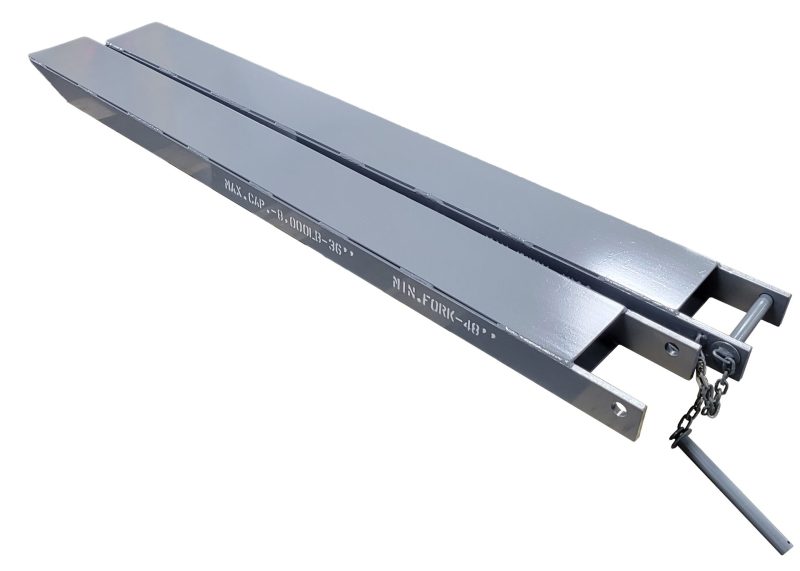
What Makes Super Duty Fork Extensions Different?
Different extension designs cover different levels of material handling.
Standard and reinforced forklift fork extensions are designed for lower-capacity applications, while boxed heavy duty fork extensions provide additional capacity and a fully enclosed fit around the existing forks.
Super Duty models take that a step further.
| Fork Extension Type | Rated Capacity per Pair |
|---|---|
| Standard | 3,500 lbs. |
| Reinforced | 3,750 lbs. |
| Heavy Duty Boxed | 4,000 lbs. |
| Reinforced Heavy Duty | 5,000 lbs. |
| Super Duty | 6,000–12,000 lbs. |
Ratings apply at the load center specified for each individual model. Always verify the selected model’s current product data, technical drawing, and capacity label.
Koke Super Duty Fork Extensions use a fully boxed, four-sided design. The top and bottom are made from hot-rolled steel plate, while the sides are constructed from hot-rolled bar stock. Models are available in 6,000-, 8,000-, 10,000-, and 12,000-lbs. capacity classes, with individual ratings tied to specified load centers.
That last point matters. A capacity rating should always be considered together with the load center at which that rating applies.
When Standard Fork Extensions May Not Be Enough
There is no single load weight or length that automatically means Super Duty is required. The complete application determines which extension is appropriate.
Higher-Capacity Loads
The clearest reason to move into the Super Duty range is when the required extension capacity exceeds what standard or heavy-duty extensions can provide.
Super Duty models are available in 6,000-, 8,000-, 10,000-, and 12,000-lbs. capacities per pair. However, the forklift itself must still have sufficient approved capacity for the load, attachment, and resulting load center.
A 12,000-lbs. extension rating does not turn a lower-capacity forklift into a 12,000-lbs. forklift.
Long or Oversized Palletized Loads
Long or oversized palletized loads and skids may require more supporting length than the truck’s original forks provide.
Additional fork length can provide more support underneath the load, but length alone does not determine whether Super Duty is necessary. A long but relatively lightweight load may require additional support without requiring a high-capacity extension.
Super Duty extensions are intended only for evenly distributed palletized loads or skids. They must not be tip-loaded, and they must always be used in pairs. The load must remain properly supported across the extensions.
Also, since a pallet opening is 3.5″H, Super Duty extensions are not used for pallets as they will not fit into the opening.
The weight of the load, its center of gravity, extension length, and the truck’s available capacity all need to be considered.
Loads That Need More Support
Some loads are difficult to handle because the existing forks do not provide enough supporting surface beneath the material.
Longer extensions can increase the amount of support under the load and reduce excessive unsupported overhang. The goal is not simply to reach farther under the material. The load should be properly distributed and positioned as close to the carriage as the application allows.
Loads must not be carried only on the tips of the extensions.
Start With the Forklift’s Capacity
Before selecting high capacity fork extensions, verify what the forklift can actually handle.
Attachments can affect forklift performance by adding weight and moving the effective load center farther forward. As the load center moves away from the fork face, the load moment increases and the truck’s available capacity can decrease.
The relationship between attachments and truck capacity is explained further in the guide to forklift truck capacity.
Before extensions are placed into service, Koke’s owner’s manual requires the forklift manufacturer to approve their use and provide updated data tags. This reflects the approval and marking requirements in OSHA 29 CFR 1910.178(a)(4) and (a)(5).
Three values therefore need to be compared:
- The actual load weight and load center
- The rated capacity of the extension pair at that load center
- The forklift’s updated approved capacity with the extensions installed
The actual load must remain within both the extension rating and the forklift’s updated approved capacity.
Measure the Original Forks
Super Duty extensions must physically match the supporting forks.
Before selecting a model, measure:
- Fork length
- Fork width
- Fork thickness
Super Duty models are designed for different original fork sizes. Depending on the model, they can accommodate forks up to 3.5 inches thick and 8 inches wide.
Do not assume that a higher-capacity extension will fit an existing fork simply because the required load capacity is correct.
Choose Extension Length Carefully
Extension length should be based on the load and the length of the supporting forks.
Under ANSI B56.1 Section 7.39.1 and Koke’s SD Series owner’s manual, the overall length of a fork extension must not exceed 150% of the supporting fork length. This means:
- A 48-inch fork can support an extension up to 72 inches long.
- A 120-inch extension requires at least an 80-inch supporting fork.
- A 156-inch extension requires at least a 104-inch supporting fork.
Buying the longest available extension is not necessarily an advantage. Additional length can move the load center farther forward and reduce the forklift’s available capacity.
Choose only the length required to properly support the intended load.
Pay Attention to Load Center
Load center is one of the most important considerations when selecting extensions for heavy material.
Forklift and extension capacities are rated at specific load centers. As the center of gravity of the load moves farther away from the fork face, the leverage applied to the truck increases.
Super Duty extension ratings therefore vary with length and load center. For example, a 120-inch 8,000-lb. model is rated at a 60-inch load center, while an 84-inch model in the same capacity class uses a 42-inch load center.
This is why load weight alone cannot determine whether an extension is suitable.
Consider Frequency of Use
Frequency of use by itself does not determine whether Super Duty extensions are required. Capacity, extension length, fork fit, and the actual load remain the primary selection factors.
Koke describes fork extensions as best suited for occasional large loads that require additional fork length. If extra-long forks are required continuously, contact Koke to determine whether removable extensions or dedicated forklift forks in the appropriate length and capacity are better suited to the application.
Regardless of frequency of use, extensions should be inspected before every use for bending, twisting, deformation, damaged welds, damaged or missing locking components, and unreadable labels. Damaged extensions should be removed from service.
Evaluate the Load and Application Together
Before choosing Super Duty fork extensions, confirm:
- Forklift capacity with the attachment installed
- Original fork length, width, and thickness
- Required extension length
- Load weight
- Load dimensions
- Load center and center of gravity
- Required extension capacity
- How the load will be distributed and supported
- Frequency of use
- Whether removable extensions are appropriate for the application
The correct forklift fork extensions need to satisfy all of these requirements rather than solving only one problem.
Selecting an extension based only on capacity can result in the wrong fork fit or length. Selecting only by length can move the load center beyond what the truck can handle in its approved configuration.
When Super Duty Fork Extensions Are the Right Choice
Super Duty fork extensions are designed for applications that need more than additional fork length. They become relevant when heavier skidded loads, longer supporting requirements, or larger existing forks push the application beyond the capacity and dimensions available with standard or heavy-duty extensions.
The key is to match the extension to the complete handling setup. A higher capacity rating only helps when the forklift has sufficient approved capacity, the extensions fit the existing forks, and the load can be supported correctly at the required load center.
For applications that require a nonstandard combination of load weight, fork dimensions, or extension length, contact us with the truck and load specifications to determine the appropriate configuration.